Listen to BMA discussing the TORCH project on Planet Possible Podcast
BMA is the lead technology partner on the collaborative TORCH project. Listen to the Planet Possible podcast about how heat from wastewater can be a source of renewable energy.
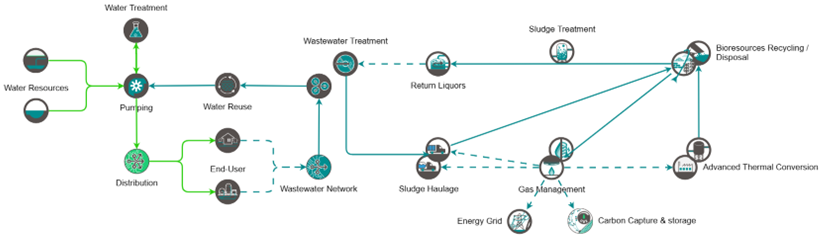
By gaining visibility of emissions across the whole operational value chain, water companies can strategically pinpoint opportunities to accelerate their journey to net zero.
The UK Government and devolved administrations, in alignment with the Committee on Climate Change, have set Net Zero targets with English water companies committed to achieving Net Zero carbon emissions by 2030, Scotland and Wales by 2040, and Northern Ireland by 2050. As water companies strive to achieve ambitious sustainability goals, they must also balance maintaining affordable quality services for a growing customer base while increasing resilience against intensifying climate change threats.
The Water UK Net Zero 2030 Routemap highlighted wastewater systems as a key focus area for reducing emissions. The water sector’s emissions stem predominantly from methane and nitrous oxide emissions from wastewater and sludge treatment processes and carbon dioxide from the use of fossil fuels, grid electricity and road transport. However, research by UK Water Industry Research (UKWIR) identified uncertainty around assumptions on nitrous oxide emissions from wastewater using the Carbon Accounting Workbook (CAW). According to UKWIR, compared to international standards, the CAW may underestimate emissions by ~8% sector wide. This significant discrepancy demonstrates the need for improved emissions quantification and decision-making tools.
By enhancing their understanding of wastewater and sludge treatment emissions, water companies can better identify pathways to reduce their emissions and progress towards ambitious decarbonisation goals, whilst remaining adaptive to changes in externalities. Tackling uncertainties in the current emissions accounting methodology, investment cost and operational changes is crucial.
Given the uncertain and complex nature of emissions reduction and required mitigation interventions, water companies need a tool to thoroughly quantify their operational emissions using various carbon accounting methods. Having a tool that enables data-driven investment decisions to meet decarbonisation goals is now more essential than ever.
“ Our Decisio™ Cloud for Water (C4W), incorporating our Digital Business Twin (DBT) focused on Net Zero Pathways, identifies risks and opportunities associated with the decarbonisation of water, wastewater, bioresources, and energy operations. ”
Our Decisio™ Cloud for Water (C4W), incorporating our Digital Business Twin (DBT) focused on Net Zero Pathways, identifies risks and opportunities associated with the decarbonisation of water, wastewater, bioresources, and energy operations. This Net Zero Pathways DBT was built to be adaptable across sectors and provides a versatile decarbonisation tool that can align with the specific technical and regulatory requirements of the water and energy sectors, as well as the broader market ecosystem. The platform optimises carbon performance, taking into consideration uncertainty around carbon pricing, costs and efficacy of remediation strategies, identifying new investments to drive decarbonisation within defined budget and time horizons.
Decisio™ Cloud for Water is our cloud-based business intelligence platform which runs on Microsoft Azure and offers a suite of Digital Business Twins including the Net Zero Pathways DBT. Given increasingly ambitious emissions targets, such intelligent decision support is essential for water companies to navigate their decarbonisation pathway.
“ Given increasingly ambitious emissions targets, such intelligent decision support is essential for water companies to navigate their decarbonisation pathway. ”
Ofwat now requires companies to develop an adaptive systems planning approach to emissions reductions in water, wastewater and bioresources systems. This requires each water company’s investments to be contextualised within a long-term framework to enable the proactive leveraging of future opportunities as they become feasible.
Decisio™ C4W – Net Zero Pathways enables water companies to contextualise their proposed investments and makes the best investment decisions for achieving emissions reductions targets. By shifting from traditional siloed-planning to data-driven adaptive systems planning, our technology produces optimal investment strategies and provides insights that drive the decisions to be made.

The Value Chain at the core of Decisio™ C4W – Net Zero Pathways
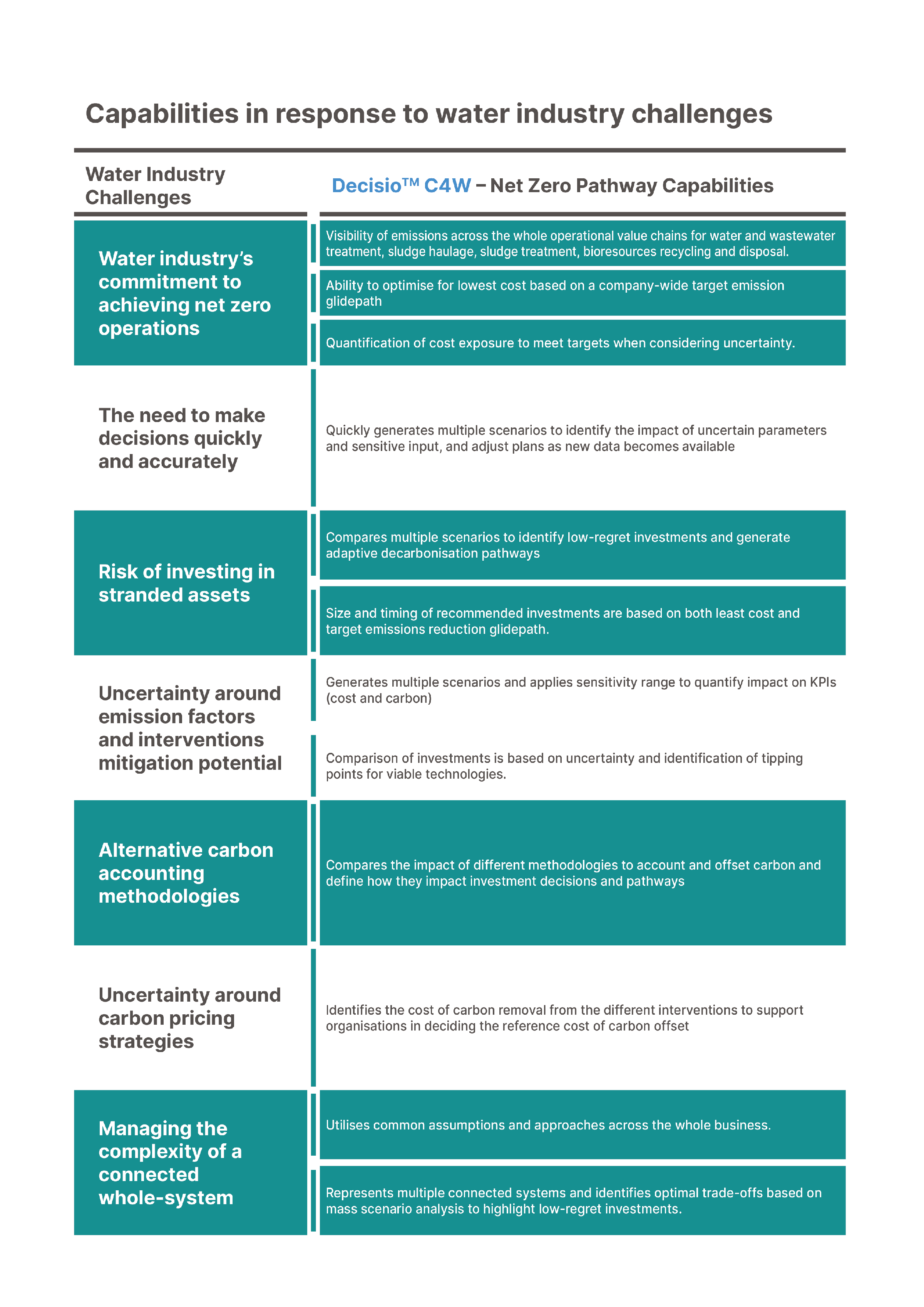
Our technology’s distinctive features, integral to the Net Zero Pathways DBT, unlock the potential for effective and efficient investment decision-making.
Key differentiators are:
A detailed list of the capabilities provided by Decisio™ C4W – Net Zero Pathways, designed to tackle challenges in the water industry-related to decarbonisation, is included in the below table.

Our Decisio™ platform runs on Microsoft Azure and therefore has access to numerous cloud-based services and associated benefits. For example, our platform can be used to augment the capabilities provided by Microsoft Cloud for Sustainability. This Microsoft tool provides access to carbon accounting, reporting and extensive emissions factor databases. When plugged into Net Zero Pathways DBT, it enhances the solution, enabling a more comprehensive approach that extends to mass scenario analysis for setting emissions reduction pathways and net zero glidepaths, assessing the costs and emissions reduction potential of remediation strategies and interventions, and managing uncertainty through a ‘true’ adaptive planning capability.
Related Articles

Listen to BMA discussing the TORCH project on Planet Possible Podcast
BMA is the lead technology partner on the collaborative TORCH project. Listen to the Planet Possible podcast about how heat from wastewater can be a source of renewable energy.
How do you use AI to deliver a future-ready energy network?
Utility Week's article looks at how our AI-assisted, adaptive planning can help utilities navigate increasing complexity — from decarbonisation and network constraints to regional delivery and long-term resilience.

Connecting regional and local planning with national strategy for a sustainable energy future.
The transition towards a sustainable energy future demands smarter, more integrated planning. We demonstrate our whole-system AI-assisted energy software application that connects regional and local planning with national strategy.